
What is the Propositional Act? [Definition & Examples]

Share this article:
copysmartly.com is independent – we research, test, and rate the top products to help you make the right buying choice. We sometimes use affiliate links and may receive a small commission on your purchase. Learn more…
Home - Definitions - What is the Propositional Act? [Definition & Examples]
What is the Propositional Act? A propositional act refers to a linguistic or communicative action wherein an individual expresses a proposition or conveys a meaning through language.

It is a cognitive and linguistic process through which individuals communicate thoughts, beliefs, or information. In the context of Language Understanding and NLU, a propositional act is crucial as it helps analyze and interpret the meaning behind spoken or written language.
Understanding Propositional Act-Definition
In NLU, a propositional act is often abbreviated as PA. This abbreviation is commonly used in research and discussions related to language processing and understanding. PAs are the building blocks for NLU systems, enabling them to discern the underlying meaning of statements, questions, or commands.
How Does Propositional Act Work?

A propositional act (PA) breaks spoken or written language into its core components, enabling a deeper understanding of the conveyed meaning. It involves analyzing linguistic cues, syntax, and context to identify the underlying message or proposition the speaker or writer intends to express. Here’s a step-by-step explanation of how propositional acts work:
Recognizing Linguistic Cues: The process begins with recognizing linguistic cues within a sentence or statement. These cues include words, phrases, and grammatical structures that convey meaning. For example, in the sentence “She believes that it will rain tomorrow,” linguistic cues include “believes,” “that,” “it,” “will,” and “rain.”
Identifying the Propositional Content: Once the linguistic cues are recognized, the next step is identifying the propositional content or the conveyed core message. In the example sentence, the propositional content is that “it will rain tomorrow.” This is the essential piece of information that the speaker is communicating.
Analyzing Syntax: The syntax or grammatical structure of the sentence is crucial in determining how the propositional content is structured. In the example, the syntax involves:
- A subject (“She”).
- A verb (“believes”).
- A subordinate clause (“that it will rain tomorrow”).
- An object of belief.
Contextual Understanding: Understanding the context in which the sentence is spoken or written is vital for accurately interpreting the propositional act. Context includes information about who speaks or writes, the situation, and any prior conversation. Context can significantly affect the interpretation of the propositional content.
Inference and Implicature: Besides the explicit content, propositional acts often involve inference and implicature. Inference involves drawing logical conclusions based on the information provided. Implicature involves understanding implied meanings that may not be explicitly stated. These elements add layers of meaning to the propositional act.

Pragmatic Considerations: Pragmatics, which deals with how language is used in specific social and communicative contexts, plays a significant role in propositional acts. Pragmatic factors such as tone, politeness, and speech acts (e.g., making requests and giving commands) influence the interpretation of the propositional act.
Natural Language Processing (NLP): In the context of Natural Language Understanding (NLU) and Natural Language Processing (NLP), machine learning algorithms and linguistic models are employed to automate the process of identifying propositional acts. These algorithms analyze large text and speech datasets to learn language use patterns and extract propositional content.
Response or Action: The identified propositional content may trigger a specific response or action depending on the application. In human-computer interaction, a virtual assistant may respond to a user’s propositional act by providing information, answering a question, or performing a requested task.
How is the Propositional Act Used?

In NLU, the propositional act extracts meaning from text or speech. This understanding of meaning goes beyond mere word recognition and delves into the semantics and pragmatics of language.
By identifying the propositional acts within a conversation or text, NLU systems can respond appropriately, answer questions, and facilitate human-computer interaction.
Why is the Propositional Act Important?
The importance of propositional acts in NLU must be balanced. They enable machines to comprehend language in a nuanced and context-aware manner.
This is vital for applications such as virtual assistants, chatbots, and language translation services, where accurate interpretation of human language is paramount for effective communication.
Propositional Act vs. Utterance- What’s The Difference?
While both propositional acts and utterances are related to language and communication, they serve different purposes:
Propositional Act (PA): Focuses on the underlying meaning or content expressed through language. It concerns the message conveyed, regardless of how it is articulated.
Utterance: Refers to the actual spoken or written expression of language, including all the nuances of pronunciation, intonation, and syntax. An utterance is the physical realization of a propositional act.
Essentially, a propositional act represents the abstract meaning, while an utterance is the concrete expression of that meaning.
Examples Of Propositional Act:
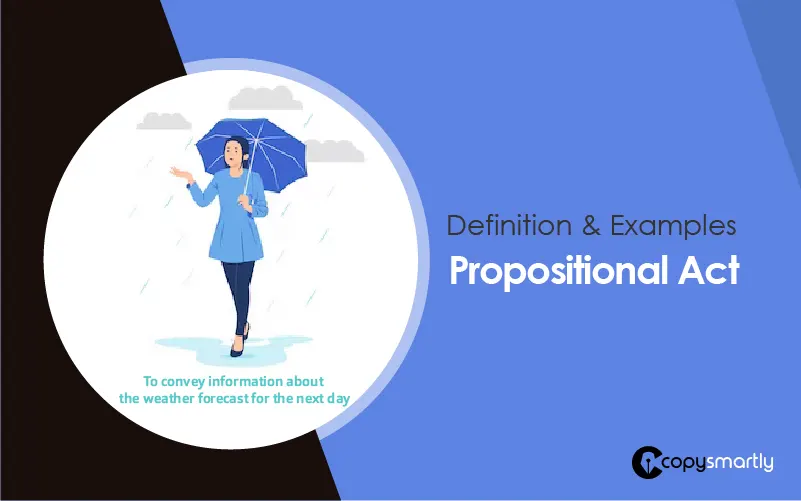
Statement: “The weather forecast predicts rain tomorrow.”
Propositional Act: To convey information about the weather forecast for the next day.
Question: “Can you pass the salt?”
Propositional Act: To request the action of passing the salt.
Command: “Please close the door.”
Propositional Act: To instruct someone to close the door.
Mistakes People Make When Using Propositional Act:
Understanding and working with propositional acts can be challenging, and common mistakes include:
Confusing Utterance with Propositional Act: People often equate spoken or written words with the intended meaning, failing to distinguish between the surface form and the underlying message.
Ignoring Context: PAs heavily depend on context for interpretation. Failing to consider the context in which a statement is made can lead to misinterpretation.
Overlooking Pragmatics: Pragmatic elements such as tone, inference, and implicature are essential in propositional acts. These aspects must be revised to ensure a complete understanding
Conclusion: What is Propositional Act?
In Natural Language Understanding, the concept of a propositional act is indispensable. It enables machines to grasp the intended meaning behind human language, fostering effective communication between humans and computers.
Understanding how propositional acts function and being aware of common pitfalls can enhance our ability to communicate clearly and enable more sophisticated NLU systems. In an age of increasing human-computer interaction, a solid grasp of propositional acts is key to bridging the gap between human language and artificial intelligence.
Related: Account
Emma Warburton
Post navigation
Previous\ Perfective Aspect: How Actions or Events are Portrayed
Next\ What is Prohibitive Mood? [Definition & Examples]
Similar Posts
![What is Prohibitive Mood? [Definition & Examples]](/media/2023-09-Prohibitive-Mood-768x480.webp)
What is Prohibitive Mood? [Definition & Examples]
ByEmma WarburtonJune 19, 2025June 19, 2025
What is Prohibitive Mood? The prohibitive mood, also known as the negative imperative, is a grammatical feature in many languages that allows speakers to express commands or requests with a sense of prohibition. On the surface level, it functions as a prohibitive message. What makes this mystical mood tick? Instead of utilizing affirmative words to…
Read More What is Prohibitive Mood? [Definition & Examples]
![What is a Simple Sentence? [Definition & Examples]](/media/2023-08-Simple-Sentence-768x480.webp)
What is a Simple Sentence? [Definition & Examples]
ByEmma WarburtonJune 19, 2025June 19, 2025
What is a Simple Sentence? A simple sentence consists of a single independent clause that expresses a complete thought and contains a subject and a predicate. Understanding Simple Sentence-Definition A Simple Sentence has the most basic elements and sentence structure known to the English language. A (S) consists of a subject (who or what is…
Read More What is a Simple Sentence? [Definition & Examples]
Perfective Aspect: How Actions or Events are Portrayed
ByEmma WarburtonJune 19, 2025June 19, 2025
What is Perfective Aspect? The perfective aspect is a grammatical concept used in linguistics to describe how actions or events are portrayed concerning their completion or fulfillment. It is one of the several aspects used in language to convey the temporal quality of an action or event. In American English, the perfective aspect is not…
Read More Perfective Aspect: How Actions or Events are Portrayed
What is Prohibitive Mood? [Definition & Examples]
ByEmma WarburtonJune 19, 2025June 19, 2025
What is Prohibitive Mood? The prohibitive mood, also known as the negative imperative, is a grammatical feature in many languages that allows speakers to express commands or requests with a sense of prohibition. On the surface level, it functions as a prohibitive message. What makes this mystical mood tick? Instead of utilizing affirmative words to…
Read More What is Prohibitive Mood? [Definition & Examples]
What is a Simple Sentence? [Definition & Examples]
ByEmma WarburtonJune 19, 2025June 19, 2025
What is a Simple Sentence? A simple sentence consists of a single independent clause that expresses a complete thought and contains a subject and a predicate. Understanding Simple Sentence-Definition A Simple Sentence has the most basic elements and sentence structure known to the English language. A (S) consists of a subject (who or what is…
Read More What is a Simple Sentence? [Definition & Examples]
Perfective Aspect: How Actions or Events are Portrayed
ByEmma WarburtonJune 19, 2025June 19, 2025
What is Perfective Aspect? The perfective aspect is a grammatical concept used in linguistics to describe how actions or events are portrayed concerning their completion or fulfillment. It is one of the several aspects used in language to convey the temporal quality of an action or event. In American English, the perfective aspect is not…
Read More Perfective Aspect: How Actions or Events are Portrayed
What is Prohibitive Mood? [Definition & Examples]
ByEmma WarburtonJune 19, 2025June 19, 2025
What is Prohibitive Mood? The prohibitive mood, also known as the negative imperative, is a grammatical feature in many languages that allows speakers to express commands or requests with a sense of prohibition. On the surface level, it functions as a prohibitive message. What makes this mystical mood tick? Instead of utilizing affirmative words to…
Read More What is Prohibitive Mood? [Definition & Examples]
What is a Simple Sentence? [Definition & Examples]
ByEmma WarburtonJune 19, 2025June 19, 2025
What is a Simple Sentence? A simple sentence consists of a single independent clause that expresses a complete thought and contains a subject and a predicate. Understanding Simple Sentence-Definition A Simple Sentence has the most basic elements and sentence structure known to the English language. A (S) consists of a subject (who or what is…
Read More What is a Simple Sentence? [Definition & Examples]
Perfective Aspect: How Actions or Events are Portrayed
ByEmma WarburtonJune 19, 2025June 19, 2025
What is Perfective Aspect? The perfective aspect is a grammatical concept used in linguistics to describe how actions or events are portrayed concerning their completion or fulfillment. It is one of the several aspects used in language to convey the temporal quality of an action or event. In American English, the perfective aspect is not…
Read More Perfective Aspect: How Actions or Events are Portrayed
What is Prohibitive Mood? [Definition & Examples]
ByEmma WarburtonJune 19, 2025June 19, 2025
What is Prohibitive Mood? The prohibitive mood, also known as the negative imperative, is a grammatical feature in many languages that allows speakers to express commands or requests with a sense of prohibition. On the surface level, it functions as a prohibitive message. What makes this mystical mood tick? Instead of utilizing affirmative words to…
Read More What is Prohibitive Mood? [Definition & Examples]
What is a Simple Sentence? [Definition & Examples]
ByEmma WarburtonJune 19, 2025June 19, 2025
What is a Simple Sentence? A simple sentence consists of a single independent clause that expresses a complete thought and contains a subject and a predicate. Understanding Simple Sentence-Definition A Simple Sentence has the most basic elements and sentence structure known to the English language. A (S) consists of a subject (who or what is…
Read More What is a Simple Sentence? [Definition & Examples]
Recent Posts

What is a Simple Sentence? [Definition & Examples]
What is Prohibitive Mood? [Definition & Examples]

Perfective Aspect: How Actions or Events are Portrayed