
What is Prohibitive Mood? [Definition & Examples]

Share this article:
copysmartly.com is independent – we research, test, and rate the top products to help you make the right buying choice. We sometimes use affiliate links and may receive a small commission on your purchase. Learn more…
Home - Definitions - What is Prohibitive Mood? [Definition & Examples]
What is Prohibitive Mood? The prohibitive mood, also known as the negative imperative, is a grammatical feature in many languages that allows speakers to express commands or requests with a sense of prohibition. On the surface level, it functions as a prohibitive message.

What makes this mystical mood tick?
Instead of utilizing affirmative words to convey orders or instructions like the imperative, the prohibitive mood leverages negative terms to take on a more intimidating tone. It operates as a barrier to stifle desired actions.
This remarkable language device commonly involves appending particular words or verb components to generate negative statements. Negative words or phrases can differ across languages, and these alterations may result in additional vocabulary.
Understanding Prohibitive Mood-Definition

The adoption of a prohibitive mood can contribute to varied purposes in communication. Defining boundaries and laws creates a framework for proper conduct. Focusing on what cannot be done helps foster responsible actions and ward off adverse consequences.
Recognizing the disparity between these two verb forms is essential. Both commands convey instructions, but imperatives direct someone towards an action, whereas prohibitives warn against a particular behaviour.
To illustrate this concept further, here are a few examples:
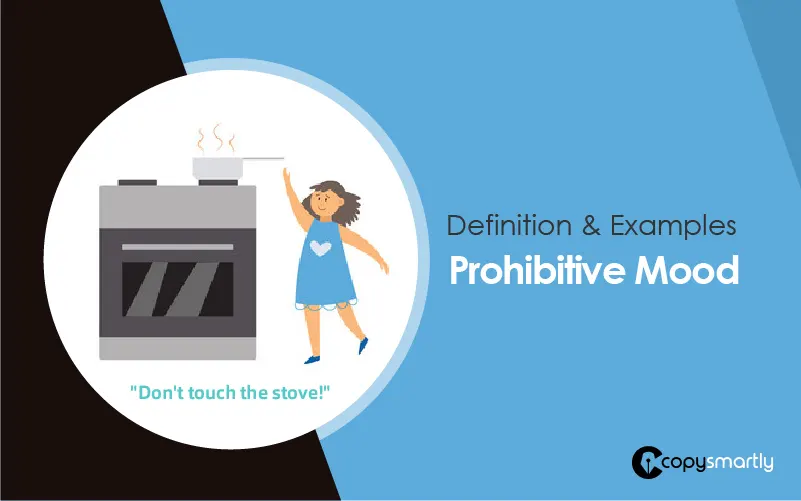
- “Don’t touch the stove!”
- “Never drive without your seatbelt!”
- “Avoid entering restricted areas.”
How Does Prohibitive Mood Work?
In essence, this mood communicates limitations or rejection using linguistic cues. The directive outlines what is forbidden. The mood frequently embodies a stern directive, warning someone against engaging in a specific behaviour.
Using “don’t” and the verb’s base form together establishes the prohibitive mood in English. For example, “Observe these guidelines and steer clear of the prohibited item!”
An intriguing characteristic of this emotional tone is its ability to be conveyed using negative terms like “never,”“no one,” or “nothing.” These language elements contribute to the intensity of our message.

The key point here is that when using the prohibitive mood, we want to emphasize what actions are off-limits rather than simply providing instructions on what should be done.
How is Prohibitive Mood Used?
One common way is using negative words such as “don’t” or “never.” For example, you might say, “Don’t touch that!” to convey your desire for someone not to touch something.
Another way prohibitive mood is used is by using specific verb forms. English speakers frequently use the verb’s base form with an adverbial adjective, creating a sense of importance in their commands. Using that particular phrase conveys emphatically that entering the location in question is off-limits.
A prohibitive attitude can be indicated through oblique hints or indirect phrasing. Rather than ordering someone not to engage in a particular behaviour directly, consider employing more oblique language, such as, “Snacking on that cake might not be the wisest choice.”
Why is Prohibitive Mood Important?

Initially, it provides the means to declare prohibitions or ban something entirely. By employing this linguistic approach, you can convey instructions with heightened precision and conviction.
Everyday interactions frequently involve imposing constraints on certain actions. Whether it’s parents instructing their children not to touch something hot or employers setting rules for their employees, the prohibitive mood plays a crucial role in establishing boundaries and ensuring compliance.
The restrictive mood lets us convey our dominance while maintaining a polite tone. Integrating these terms preserves a polite tone while instilling an air of seriousness. It is crucial in professional environments where articulate exchange fosters harmonious collaboration and efficiency.
Prohibitive Mood vs. Imperative Mood- What’s The Difference?
These two concepts are closely tied but have distinct characteristics within grammar. While both moods impart a feeling of direction, their variances can greatly affect the interpretation of a sentence.
Fundamentally, the imperative mode involves using clear and direct language to convey instructions. From the most basic form of a verb, these directions unfold (e.g., “Open the door,”“Clean your room”). This grammatical form enables a clear expression of commands or suggestions.
On the contrary, a prohibitive mood signifies prohibition or rejection. The instruction serves as a restriction, preventing particular actions. Considering examples, we notice that “Don’t touch that!” and “Don’t speak poorly of someone” utilize the prohibitive mode.
The distinct aim of each mood is manifest in their respective effects on the recipient. Imperatives prompt the recipient to take necessary steps, whereas prohibitive sentences are designed to restrict particular acts or conduct.
Appreciating the contrast allows us to develop targeted and refined communication methods across multiple realms. When we intend someone to act swiftly (urgent) or desist from particular actions (forbidden), selecting the suitable grammatical form enables us to communicate our goals more expressively.
Examples Of Prohibitive Mood:
The prohibitive mood is a grammatical mood used to express prohibition or a negative command. It is often used to tell someone not to do something.
Here are some examples of the prohibitive mood in various languages:
- Don’t touch that!
- Don’t go there.
- Never smoke in here.
Mistakes People Make When Using Prohibitive Mood:
Although it may be uncomplicated in several tongues, certain errors persist when employing the prohibitive tone. Here are some of them:
- Using the wrong verb form: Some languages feature divergent verb forms for the prohibitive and direct commands. To illustrate, in English, the standard mandate utilizes the verb’s unchanged base form (e.g., “Conduct your homework”). In contrast, the restricted mood necessitates adding “Do not” ahead of time (e.g., “Steer clear of interacting with the stove”). Unknowingly, individuals may adopt the command form over the prohibition form.
- Incorrect negation: Incorrect usage can arise when the affirmative verb form is applied in a prohibitive situation. For instance, “Do not give me your money” would be a better choice.
To avoid these mistakes, it’s essential to practice using the prohibitive mood in context and pay attention to the specific rules and conventions of your language. Furthermore, being considerate towards others during communication can facilitate positive interactions.
Conclusion: What is Prohibitive Mood?
To conclude, the prohibitive mood conveys an instruction not to perform a particular action. Such negation is typically employed in language, as seen in expressions like “don’t” in English, preceding the basic verb form. The prohibitive mood facilitates effective communication of restrictions by employing an appropriately restrictive tone.
Related: Account
Emma Warburton
Post navigation
Previous\ What is the Propositional Act? [Definition & Examples]
Next\ What is a Simple Sentence? [Definition & Examples]
Similar Posts
![What is a Simple Sentence? [Definition & Examples]](/media/2023-08-Simple-Sentence-768x480.webp)
What is a Simple Sentence? [Definition & Examples]
ByEmma WarburtonJune 19, 2025June 19, 2025
What is a Simple Sentence? A simple sentence consists of a single independent clause that expresses a complete thought and contains a subject and a predicate. Understanding Simple Sentence-Definition A Simple Sentence has the most basic elements and sentence structure known to the English language. A (S) consists of a subject (who or what is…
Read More What is a Simple Sentence? [Definition & Examples]
![What is the Propositional Act? [Definition & Examples]](/media/2023-09-Propositional-Act-768x480.webp)
What is the Propositional Act? [Definition & Examples]
ByEmma WarburtonJune 19, 2025June 19, 2025
What is the Propositional Act? A propositional act refers to a linguistic or communicative action wherein an individual expresses a proposition or conveys a meaning through language. It is a cognitive and linguistic process through which individuals communicate thoughts, beliefs, or information. In the context of Language Understanding and NLU, a propositional act is crucial…
Read More What is the Propositional Act? [Definition & Examples]
Perfective Aspect: How Actions or Events are Portrayed
ByEmma WarburtonJune 19, 2025June 19, 2025
What is Perfective Aspect? The perfective aspect is a grammatical concept used in linguistics to describe how actions or events are portrayed concerning their completion or fulfillment. It is one of the several aspects used in language to convey the temporal quality of an action or event. In American English, the perfective aspect is not…
Read More Perfective Aspect: How Actions or Events are Portrayed
What is a Simple Sentence? [Definition & Examples]
ByEmma WarburtonJune 19, 2025June 19, 2025
What is a Simple Sentence? A simple sentence consists of a single independent clause that expresses a complete thought and contains a subject and a predicate. Understanding Simple Sentence-Definition A Simple Sentence has the most basic elements and sentence structure known to the English language. A (S) consists of a subject (who or what is…
Read More What is a Simple Sentence? [Definition & Examples]
What is the Propositional Act? [Definition & Examples]
ByEmma WarburtonJune 19, 2025June 19, 2025
What is the Propositional Act? A propositional act refers to a linguistic or communicative action wherein an individual expresses a proposition or conveys a meaning through language. It is a cognitive and linguistic process through which individuals communicate thoughts, beliefs, or information. In the context of Language Understanding and NLU, a propositional act is crucial…
Read More What is the Propositional Act? [Definition & Examples]
Perfective Aspect: How Actions or Events are Portrayed
ByEmma WarburtonJune 19, 2025June 19, 2025
What is Perfective Aspect? The perfective aspect is a grammatical concept used in linguistics to describe how actions or events are portrayed concerning their completion or fulfillment. It is one of the several aspects used in language to convey the temporal quality of an action or event. In American English, the perfective aspect is not…
Read More Perfective Aspect: How Actions or Events are Portrayed
What is a Simple Sentence? [Definition & Examples]
ByEmma WarburtonJune 19, 2025June 19, 2025
What is a Simple Sentence? A simple sentence consists of a single independent clause that expresses a complete thought and contains a subject and a predicate. Understanding Simple Sentence-Definition A Simple Sentence has the most basic elements and sentence structure known to the English language. A (S) consists of a subject (who or what is…
Read More What is a Simple Sentence? [Definition & Examples]
What is the Propositional Act? [Definition & Examples]
ByEmma WarburtonJune 19, 2025June 19, 2025
What is the Propositional Act? A propositional act refers to a linguistic or communicative action wherein an individual expresses a proposition or conveys a meaning through language. It is a cognitive and linguistic process through which individuals communicate thoughts, beliefs, or information. In the context of Language Understanding and NLU, a propositional act is crucial…
Read More What is the Propositional Act? [Definition & Examples]
Perfective Aspect: How Actions or Events are Portrayed
ByEmma WarburtonJune 19, 2025June 19, 2025
What is Perfective Aspect? The perfective aspect is a grammatical concept used in linguistics to describe how actions or events are portrayed concerning their completion or fulfillment. It is one of the several aspects used in language to convey the temporal quality of an action or event. In American English, the perfective aspect is not…
Read More Perfective Aspect: How Actions or Events are Portrayed
What is a Simple Sentence? [Definition & Examples]
ByEmma WarburtonJune 19, 2025June 19, 2025
What is a Simple Sentence? A simple sentence consists of a single independent clause that expresses a complete thought and contains a subject and a predicate. Understanding Simple Sentence-Definition A Simple Sentence has the most basic elements and sentence structure known to the English language. A (S) consists of a subject (who or what is…
Read More What is a Simple Sentence? [Definition & Examples]
What is the Propositional Act? [Definition & Examples]
ByEmma WarburtonJune 19, 2025June 19, 2025
What is the Propositional Act? A propositional act refers to a linguistic or communicative action wherein an individual expresses a proposition or conveys a meaning through language. It is a cognitive and linguistic process through which individuals communicate thoughts, beliefs, or information. In the context of Language Understanding and NLU, a propositional act is crucial…
Read More What is the Propositional Act? [Definition & Examples]
Recent Posts

What is a Simple Sentence? [Definition & Examples]
What is the Propositional Act? [Definition & Examples]

Perfective Aspect: How Actions or Events are Portrayed