
Perfective Aspect: How Actions or Events are Portrayed

Share this article:
copysmartly.com is independent – we research, test, and rate the top products to help you make the right buying choice. We sometimes use affiliate links and may receive a small commission on your purchase. Learn more…
Home - Definitions - Perfective Aspect: How Actions or Events are Portrayed
What is Perfective Aspect ? The perfective aspect is a grammatical concept used in linguistics to describe how actions or events are portrayed concerning their completion or fulfillment. It is one of the several aspects used in language to convey the temporal quality of an action or event.

In American English, the perfective aspect is not as prominently marked as in other languages, such as Russian or Slavic, where verb conjugation is used to denote the perfective aspect explicitly. However, it still plays an essential role in conveying the completeness or totality of an action or event.
Language is a dynamic and intricate system with numerous nuances and elements contributing to effective communication. One such element is the perfective aspect.
This comprehensive guide will explore the perfective aspect, how it functions, its importance, and practical usage through examples. Understanding the perfective aspect is vital for expressingactions and events clearly and precisely in American English.
Understanding of Perfective Aspect-Definition

The perfective aspect focuses on presenting an action or event as a whole, emphasizing its completion. It is often used to describe actions that have already been accomplished or those seen as a single, discrete event rather than a continuous or ongoing process.
The perfective aspect can be understood through the following key points:
Completion: The perfective aspect emphasizes that an action or event has been completed or is viewed in its entirety. It often answers the question, “What happened?”
Single Events: It is commonly used to describe single, specific actions or events rather than ongoing, habitual actions. For instance, narrating a past occurrence or recounting a specific event.
A moment in Time: The perfective aspect often denotes an action that happened at a specific moment, with clear boundaries.
Specificity: It is associated with specific instances and actions, emphasizing the precise details of the event.
How Does Perfective Aspect Work?
The perfective aspect is conveyed through language in various ways, depending on the language itself. In some languages, it is marked explicitly through verb conjugation or specific auxiliary verbs. In American English, however, the perfective aspect is typically conveyed through context, verb tense, and adverbs.

Here’s how it works in English:
Verb Tense: The choice of verb tense can indicate the perfective aspect. For example, the past simple tense (“I finished the work”) often implies a completed, perfective action.
Adverbs and Adverbial Phrases: Certain adverbs and adverbial phrases can be used to emphasize the completion of an action. For instance, “She completed the task promptly.”
Context: Context plays a significant role in conveying the perfective aspect. The specific details of the situation or event can make it clear that the action is seen as a whole.
How is Perfective Aspect Used?

The perfective aspect provides a clear and precise account of actions or events. It is commonly used in various situations:
Narration: When telling stories, recounting past events, or providing a detailed account of an occurrence, the perfective aspect conveys the completeness and totality of those actions.
Specific Instructions: In instructions or commands, the perfective aspect can ensure that the action is carried out to its conclusion. For example, “Finish your homework.”
Describing Achievements: The perfective aspect describes achievements, accomplishments, or milestones. For instance, “He won the championship.”
Summarizing Events: In academic or formal writing, the perfective aspect is often used to summarize events succinctly. For example, “The meeting concluded successfully.”
Why is a Perfective Aspect Important?
The perfective aspect is important for several reasons:
Clarity: It provides an unambiguous way to convey the completeness of actions and events. This clarity is crucial for effective communication.
Specificity: It allows speakers and writers to focus on individual, specific events or actions, which is particularly useful in storytelling, reporting, and academic writing.
Temporal Precision: The perfective aspect helps indicate when an action was completed, making it easier to understand the temporal aspect of an event.
Instruction and Command: In an instructional or imperative language, the perfective aspect ensures that actions are performed fully and effectively.
Perfective Aspect vs. Possessive Adjective – What’s The Difference
It’s essential to differentiate between the perfective aspect and other grammatical concepts to avoid confusion. In this case, we’ll clarify the difference between the perfective aspect and possessive adjectives:
Perfective Aspect: The perfective aspect deals with the completeness and totality of actions or events. It focuses on whether an action is seen as a whole and emphasizes the idea of completion or fulfillment.
Possessive Adjectives: Possessive adjectives are used to indicate ownership or possession. They are words like “my,” “your,” “his,” “her,” “our,” and “their,” which modify nouns to show who possesses or owns them.
For example:
Perfective Aspect: “She finished the book in one sitting.” (Emphasizing the completion of reading the book)
Possessive Adjective: “Her book is on the shelf.” (Showing ownership of the book)
Examples Of Perfective Aspect:
Let’s explore some examples of the perfective aspect in sentences to illustrate its usage:
Narration:
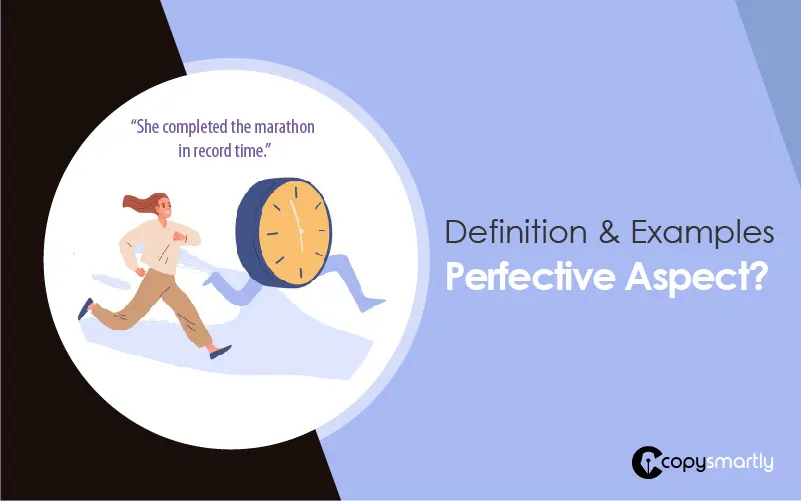
“She completed the marathon in record time.”
“He painted the entire house last weekend.”
“They visited all the museums during their trip.”
Specific Instructions:
Finish your dinner before you leave the table.”
“Complete the assignment by Friday.”
“Close the door when you leave.”
Describing Achievements:
“She won the gold medal in the competition.”
“He graduated with honors.”
“They successfully launched the product.”
Summarizing Events:
“The conference concluded with a keynote speech.”
“The project wrapped up ahead of schedule.”
“The investigation ended with no significant findings.”
Mistakes People Make with Perfective Aspects:
While the perfective aspect is a relatively straightforward concept in English, people make common things in its usage to correct. These mistakes can lead to confusion or miscommunication.
Here are some errors to be aware of:
Using the wrong tense: Misusing verb tenses can make the intended perfective aspect clearer. For instance, saying “I am finishing the project” implies ongoing action rather than completion.
Overusing adverbs: While adverbs and adverbial phrases can emphasize completion, using them excessively can make sentences verbose and less effective.
Failure to consider context: Sometimes, the perfective aspect relies heavily on context. Failing to provide adequate context can lead to misunderstandings.
Conclusion: What is Perfective Aspect?
The perfective aspect is a valuable linguistic tool for emphasizing the completeness and totality of actions or events. It contributes to clarity and precision in communication, making it an essential concept in American English.
By understanding how the perfective aspect works, its importance, and potential pitfalls to avoid, you can effectively convey events and actions with precision and completeness.
Related: Account
Emma Warburton
Post navigation
Previous\ Expository Writing [Everything You Need to Know]
Next\ What is the Propositional Act? [Definition & Examples]
Similar Posts
![What is a Simple Sentence? [Definition & Examples]](/media/2023-08-Simple-Sentence-768x480.webp)
What is a Simple Sentence? [Definition & Examples]
ByEmma WarburtonJune 19, 2025June 19, 2025
What is a Simple Sentence? A simple sentence consists of a single independent clause that expresses a complete thought and contains a subject and a predicate. Understanding Simple Sentence-Definition A Simple Sentence has the most basic elements and sentence structure known to the English language. A (S) consists of a subject (who or what is…
Read More What is a Simple Sentence? [Definition & Examples]
![What is the Propositional Act? [Definition & Examples]](/media/2023-09-Propositional-Act-768x480.webp)
What is the Propositional Act? [Definition & Examples]
ByEmma WarburtonJune 19, 2025June 19, 2025
What is the Propositional Act? A propositional act refers to a linguistic or communicative action wherein an individual expresses a proposition or conveys a meaning through language. It is a cognitive and linguistic process through which individuals communicate thoughts, beliefs, or information. In the context of Language Understanding and NLU, a propositional act is crucial…
Read More What is the Propositional Act? [Definition & Examples]
![What is Prohibitive Mood? [Definition & Examples]](/media/2023-09-Prohibitive-Mood-768x480.webp)
What is Prohibitive Mood? [Definition & Examples]
ByEmma WarburtonJune 19, 2025June 19, 2025
What is Prohibitive Mood? The prohibitive mood, also known as the negative imperative, is a grammatical feature in many languages that allows speakers to express commands or requests with a sense of prohibition. On the surface level, it functions as a prohibitive message. What makes this mystical mood tick? Instead of utilizing affirmative words to…
Read More What is Prohibitive Mood? [Definition & Examples]
What is a Simple Sentence? [Definition & Examples]
ByEmma WarburtonJune 19, 2025June 19, 2025
What is a Simple Sentence? A simple sentence consists of a single independent clause that expresses a complete thought and contains a subject and a predicate. Understanding Simple Sentence-Definition A Simple Sentence has the most basic elements and sentence structure known to the English language. A (S) consists of a subject (who or what is…
Read More What is a Simple Sentence? [Definition & Examples]
What is the Propositional Act? [Definition & Examples]
ByEmma WarburtonJune 19, 2025June 19, 2025
What is the Propositional Act? A propositional act refers to a linguistic or communicative action wherein an individual expresses a proposition or conveys a meaning through language. It is a cognitive and linguistic process through which individuals communicate thoughts, beliefs, or information. In the context of Language Understanding and NLU, a propositional act is crucial…
Read More What is the Propositional Act? [Definition & Examples]
What is Prohibitive Mood? [Definition & Examples]
ByEmma WarburtonJune 19, 2025June 19, 2025
What is Prohibitive Mood? The prohibitive mood, also known as the negative imperative, is a grammatical feature in many languages that allows speakers to express commands or requests with a sense of prohibition. On the surface level, it functions as a prohibitive message. What makes this mystical mood tick? Instead of utilizing affirmative words to…
Read More What is Prohibitive Mood? [Definition & Examples]
What is a Simple Sentence? [Definition & Examples]
ByEmma WarburtonJune 19, 2025June 19, 2025
What is a Simple Sentence? A simple sentence consists of a single independent clause that expresses a complete thought and contains a subject and a predicate. Understanding Simple Sentence-Definition A Simple Sentence has the most basic elements and sentence structure known to the English language. A (S) consists of a subject (who or what is…
Read More What is a Simple Sentence? [Definition & Examples]
What is the Propositional Act? [Definition & Examples]
ByEmma WarburtonJune 19, 2025June 19, 2025
What is the Propositional Act? A propositional act refers to a linguistic or communicative action wherein an individual expresses a proposition or conveys a meaning through language. It is a cognitive and linguistic process through which individuals communicate thoughts, beliefs, or information. In the context of Language Understanding and NLU, a propositional act is crucial…
Read More What is the Propositional Act? [Definition & Examples]
What is Prohibitive Mood? [Definition & Examples]
ByEmma WarburtonJune 19, 2025June 19, 2025
What is Prohibitive Mood? The prohibitive mood, also known as the negative imperative, is a grammatical feature in many languages that allows speakers to express commands or requests with a sense of prohibition. On the surface level, it functions as a prohibitive message. What makes this mystical mood tick? Instead of utilizing affirmative words to…
Read More What is Prohibitive Mood? [Definition & Examples]
What is a Simple Sentence? [Definition & Examples]
ByEmma WarburtonJune 19, 2025June 19, 2025
What is a Simple Sentence? A simple sentence consists of a single independent clause that expresses a complete thought and contains a subject and a predicate. Understanding Simple Sentence-Definition A Simple Sentence has the most basic elements and sentence structure known to the English language. A (S) consists of a subject (who or what is…
Read More What is a Simple Sentence? [Definition & Examples]
What is the Propositional Act? [Definition & Examples]
ByEmma WarburtonJune 19, 2025June 19, 2025
What is the Propositional Act? A propositional act refers to a linguistic or communicative action wherein an individual expresses a proposition or conveys a meaning through language. It is a cognitive and linguistic process through which individuals communicate thoughts, beliefs, or information. In the context of Language Understanding and NLU, a propositional act is crucial…
Read More What is the Propositional Act? [Definition & Examples]
Recent Posts

What is a Simple Sentence? [Definition & Examples]
What is Prohibitive Mood? [Definition & Examples]
What is the Propositional Act? [Definition & Examples]