
What is a Simple Sentence? [Definition & Examples]

Share this article:
copysmartly.com is independent – we research, test, and rate the top products to help you make the right buying choice. We sometimes use affiliate links and may receive a small commission on your purchase. Learn more…
Home - Definitions - What is a Simple Sentence? [Definition & Examples]
What is a Simple Sentence? A simple sentence consists of a single independent clause that expresses a complete thought and contains a subject and a predicate.
Understanding Simple Sentence-Definition
A Simple Sentence has the most basic elements and sentence structure known to the English language. A (S) consists of a subject (who or what is doing the action), a verb (an action), and a completed thought.

Also referred to as an independent clause, this might be used as a part of a complex or compound sentence; however, it can also stand by itself as a complete sentence.
How Does Simple Sentence Work?
A simple sentence only has an independent clause containing a subject and a predicate. Who or what the sentence is about or the thing that does the action is called the subject.
The predicate contains the verb/ verb phrase or action, which can also be a linking verb that connects the subject and another noun or adjective. Common examples of linking verbs are am, is, are, were, had, has, etc.
Simple sentences may contain multiple subjects or verbs and still be considered simple sentences as long as no other independent or dependent clause is added. A clause is a group of words forming parts of sentences.
An independent or main clause forms a sentence when placed by itself, whereas a dependent or subordinate clause cannot stand alone and is used to complement the independent clause. A (S) has no dependent clauses.
A simple sentence may also include compound subjects, verbs and prepositional phrases. Contrary to popular belief, a (S) must be longer and more basic. It could have a compound subject, which is a subject that has two or more simple subjects.
**For Example,**Gillian is having fun. (“Gillian” is the single subject in this simple sentence.) Gillian and Alice are having fun. (“Gillian and Alice” is a compound subject, with two simple subjects, in this simple sentence.)
How is Simple Sentence Used?

In spoken and written words, simple sentences are generally used to give direct and clear information to communicate clearly and make important points.
They are ideal for giving informative instructions that are easier to understand. e.g. Recipes, directions, etc.
After the details of a compound sentence, a simple sentence can also be used to summarize the compound sentence’s main point and add impact.
Why is a Simple Sentence Important?
Simple sentences make communication easier to understand because they are short, which helps the speaker get their point across clearly and concisely.
A (S) requires no supporting material to convey its message because it makes sense independently and has no additional information.
They are also the first types of sentences students learn to write because they are easy to understand and apply.
Simple Sentence vs. Compound Sentence – What’s The Difference?
English has three main sentence structures: simple, compound and complex. Today, we will compare the difference between simple and compound sentences.

As mentioned, a simple sentence only contains one independent clause, whereas a compound sentence contains at least two or even more independent clauses. This means a compound sentence has more than one subject and predicate.
It is best used when combining two or more simple sentences that make their own sense into one whole sentence. This is done using coordinating conjunctions/connectors to join the clauses.
Words placed between clauses, sentences, phrases and words that rank equally grammatically, such as for, and, nor, but, or, yet, so. Unlike simple sentences, compound sentences add depth to your writing and conjoin ideas that relate to each other. However, they have slightly more guidelines than traditional simple sentence structures.
Here’s an example of a compound sentence:
Harold takes the bus, and the bus is leaving at 9:00.
Examples Of Simple Sentence:

Now, let’s take a look at some examples.
Here are some simple sentences to observe:
The verb in the sentence is highlighted in green.
The subject in the sentence is highlighted in red.
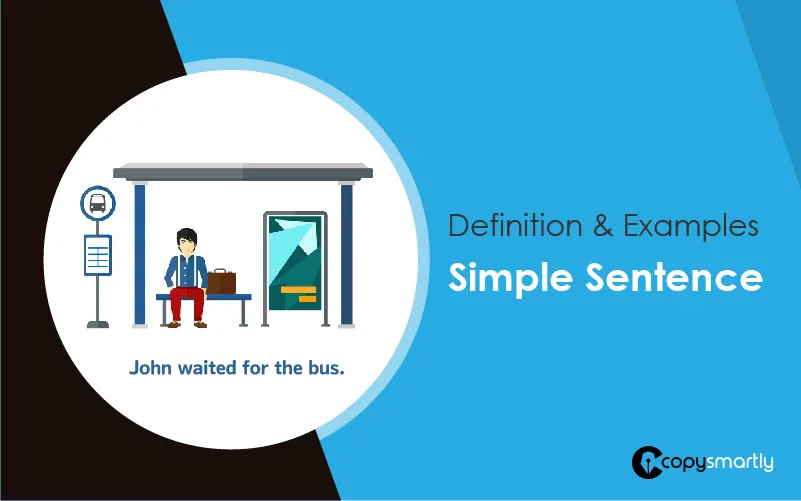
- Alice waited for the bus.
- His school begins at 8:00.
- Jonah doesn’t speak Afrikaans.
- Gillian got the job.
- My friends and I walked to the shop.
Mistakes People Make When Using Simple Sentence:
Simple sentences are usually an easy concept to understand. However, people often make silly mistakes, which is normal when learning a new language. A (S) must form a complete thought; when a sentencelacks a complete thought, it leaves the reader anticipating the missing information. This is an all too common mistake.
When writing, using too many simple sentences makes your writing look flat or very simplistic and requires you to utilize more words to say something that could have been said in a few compound sentences.
Generally, simple sentences are quite short, and when you use them in paragraphs, essays, speeches or articles, ensure that you thoughtfully use them not to make your writing look smooth. A typical mistake is when a piece of writing needs to use all the various sentence structures.
Conclusion: What is a Simple Sentence?
To write effectively, it is encouraged to use various sentence types as mentioned above, including Simple, Compound and Complex**. Incorporating**all of these sentence structures in your writing can help you elevate your writing style tremendously.
When learning to write and communicate, simple sentences are an important, basic part of your education and a skill essential to develop and master. Because simple sentences only include one independent clause, they are most likely the sentences that children first learn to read and write. In conclusion, simple sentences are an important tool to form a solid foundation in your English education.
Related: Account
Emma Warburton
Post navigation
Previous\ What is Prohibitive Mood? [Definition & Examples]
Similar Posts
Perfective Aspect: How Actions or Events are Portrayed
ByEmma WarburtonJune 19, 2025June 19, 2025
What is Perfective Aspect? The perfective aspect is a grammatical concept used in linguistics to describe how actions or events are portrayed concerning their completion or fulfillment. It is one of the several aspects used in language to convey the temporal quality of an action or event. In American English, the perfective aspect is not…
Read More Perfective Aspect: How Actions or Events are Portrayed
![What is the Propositional Act? [Definition & Examples]](/media/2023-09-Propositional-Act-768x480.webp)
What is the Propositional Act? [Definition & Examples]
ByEmma WarburtonJune 19, 2025June 19, 2025
What is the Propositional Act? A propositional act refers to a linguistic or communicative action wherein an individual expresses a proposition or conveys a meaning through language. It is a cognitive and linguistic process through which individuals communicate thoughts, beliefs, or information. In the context of Language Understanding and NLU, a propositional act is crucial…
Read More What is the Propositional Act? [Definition & Examples]
![What is Prohibitive Mood? [Definition & Examples]](/media/2023-09-Prohibitive-Mood-768x480.webp)
What is Prohibitive Mood? [Definition & Examples]
ByEmma WarburtonJune 19, 2025June 19, 2025
What is Prohibitive Mood? The prohibitive mood, also known as the negative imperative, is a grammatical feature in many languages that allows speakers to express commands or requests with a sense of prohibition. On the surface level, it functions as a prohibitive message. What makes this mystical mood tick? Instead of utilizing affirmative words to…
Read More What is Prohibitive Mood? [Definition & Examples]
Perfective Aspect: How Actions or Events are Portrayed
ByEmma WarburtonJune 19, 2025June 19, 2025
What is Perfective Aspect? The perfective aspect is a grammatical concept used in linguistics to describe how actions or events are portrayed concerning their completion or fulfillment. It is one of the several aspects used in language to convey the temporal quality of an action or event. In American English, the perfective aspect is not…
Read More Perfective Aspect: How Actions or Events are Portrayed
What is the Propositional Act? [Definition & Examples]
ByEmma WarburtonJune 19, 2025June 19, 2025
What is the Propositional Act? A propositional act refers to a linguistic or communicative action wherein an individual expresses a proposition or conveys a meaning through language. It is a cognitive and linguistic process through which individuals communicate thoughts, beliefs, or information. In the context of Language Understanding and NLU, a propositional act is crucial…
Read More What is the Propositional Act? [Definition & Examples]
What is Prohibitive Mood? [Definition & Examples]
ByEmma WarburtonJune 19, 2025June 19, 2025
What is Prohibitive Mood? The prohibitive mood, also known as the negative imperative, is a grammatical feature in many languages that allows speakers to express commands or requests with a sense of prohibition. On the surface level, it functions as a prohibitive message. What makes this mystical mood tick? Instead of utilizing affirmative words to…
Read More What is Prohibitive Mood? [Definition & Examples]
Perfective Aspect: How Actions or Events are Portrayed
ByEmma WarburtonJune 19, 2025June 19, 2025
What is Perfective Aspect? The perfective aspect is a grammatical concept used in linguistics to describe how actions or events are portrayed concerning their completion or fulfillment. It is one of the several aspects used in language to convey the temporal quality of an action or event. In American English, the perfective aspect is not…
Read More Perfective Aspect: How Actions or Events are Portrayed
What is the Propositional Act? [Definition & Examples]
ByEmma WarburtonJune 19, 2025June 19, 2025
What is the Propositional Act? A propositional act refers to a linguistic or communicative action wherein an individual expresses a proposition or conveys a meaning through language. It is a cognitive and linguistic process through which individuals communicate thoughts, beliefs, or information. In the context of Language Understanding and NLU, a propositional act is crucial…
Read More What is the Propositional Act? [Definition & Examples]
What is Prohibitive Mood? [Definition & Examples]
ByEmma WarburtonJune 19, 2025June 19, 2025
What is Prohibitive Mood? The prohibitive mood, also known as the negative imperative, is a grammatical feature in many languages that allows speakers to express commands or requests with a sense of prohibition. On the surface level, it functions as a prohibitive message. What makes this mystical mood tick? Instead of utilizing affirmative words to…
Read More What is Prohibitive Mood? [Definition & Examples]
Perfective Aspect: How Actions or Events are Portrayed
ByEmma WarburtonJune 19, 2025June 19, 2025
What is Perfective Aspect? The perfective aspect is a grammatical concept used in linguistics to describe how actions or events are portrayed concerning their completion or fulfillment. It is one of the several aspects used in language to convey the temporal quality of an action or event. In American English, the perfective aspect is not…
Read More Perfective Aspect: How Actions or Events are Portrayed
What is the Propositional Act? [Definition & Examples]
ByEmma WarburtonJune 19, 2025June 19, 2025
What is the Propositional Act? A propositional act refers to a linguistic or communicative action wherein an individual expresses a proposition or conveys a meaning through language. It is a cognitive and linguistic process through which individuals communicate thoughts, beliefs, or information. In the context of Language Understanding and NLU, a propositional act is crucial…
Read More What is the Propositional Act? [Definition & Examples]
Recent Posts
What is Prohibitive Mood? [Definition & Examples]
What is the Propositional Act? [Definition & Examples]
Perfective Aspect: How Actions or Events are Portrayed